Cheapest TV Subscription Hungary 2026: IPTV, Cable & mindigTV
Cheapest TV subscription in Hungary 2026: IPTV, Magenta TV, One TV, Flip and mindigTV prices, packages and saving tips compared in one guide.
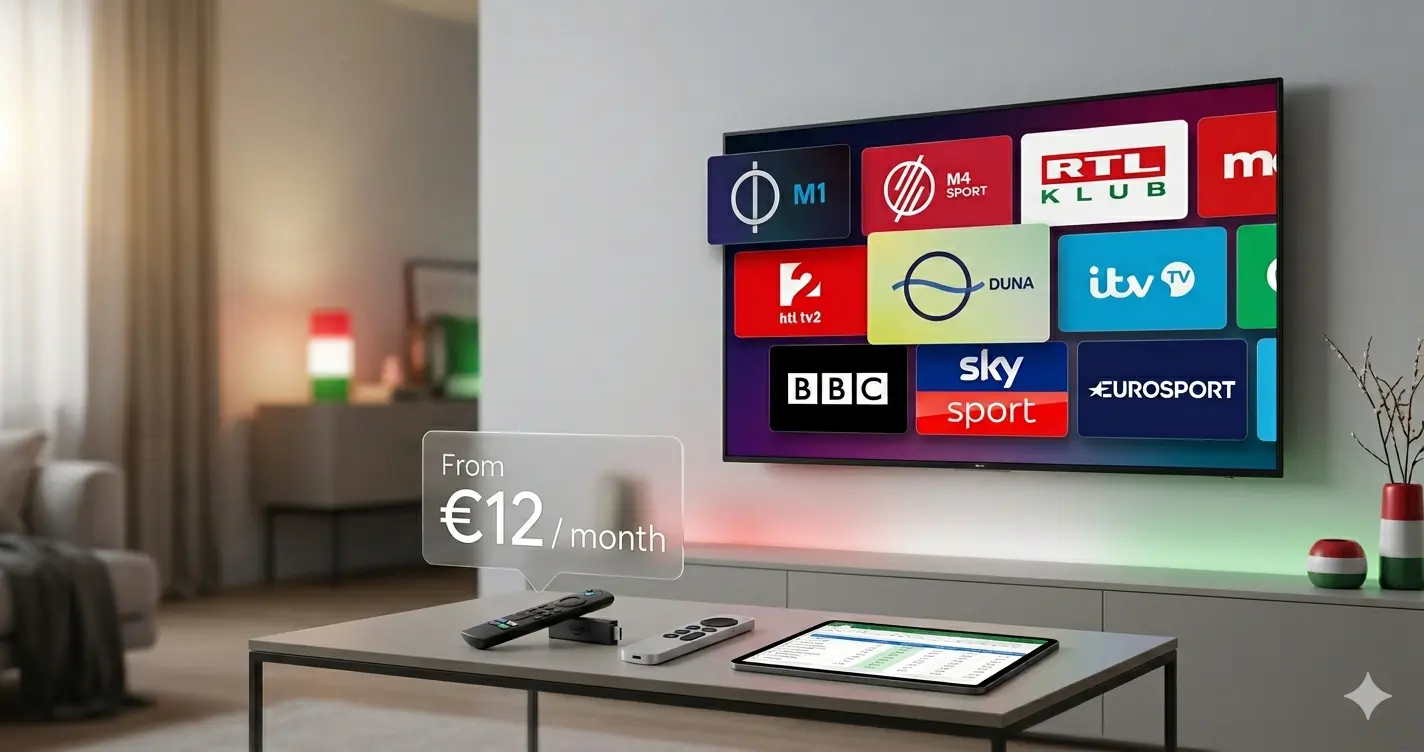
The cheapest TV subscription in Hungary in 2026 is no longer the entry-level cable package or the over-the-air mindigTV — it's an IPTV subscription delivered over the internet for as little as €5 (~1 990 HUF) per month, with 48 000+ channels in 4K, no contract, and no installation visit. The market has shifted: after the DIGI–Vodafone merger into One Hungary (1 January 2025), the price-freeze expiry in July 2026, and Telekom's Magenta TV price increases, Hungarian households can save €80–€200 per year (≈ 30 000–80 000 HUF) on their TV subscription if they know exactly what they watch and which package fits them.
Quick summary:
- The cheapest full TV subscription in Hungary in 2026 is IPTV: the annual Basic plan works out to €5/month (€60/year) for 48,000+ channels, with no contract.
- mindigTV Prémium Alap costs 3,290 HUF/month for about 30 channels over DVB-T2 — no dish, no cable.
- Operator base packages — Magenta TV S and Flip TV (both 4,990 HUF), One TV Mini (5,290 HUF) — carry 1–2-year contracts.
- The DIGI/One price freeze expires in July 2026, with announced 15–25% increases on cable packages.
- IPTV activation takes 5 minutes via apps like IPTV Smarters Pro or TiviMate — no technician visit.
Key Takeaways
- The cheapest TV subscription in Hungary in 2026 is IPTV — €5/month flat, 48 000+ channels, 4K UHD, no contract.
- Operator base packages start at 4 990–7 990 HUF/month (Magenta TV, One TV, Flip), almost always with 1–2 year contracts.
- mindigTV Prémium Alap is 3 290 HUF/month — over-the-air digital TV, ~30 channels, no dish, no cable.
- The DIGI/One price freeze ends July 2026, with announced 15–25 % increases on cable packages.
- Streaming platforms (Netflix, HBO Max, SkyShowtime) are 1 990–5 700 HUF/month each — none of them carry live Hungarian channels.
- 30 000–80 000 HUF/year savings are realistic with IPTV vs. traditional cable.
Table of Contents
- What is the cheapest TV subscription in Hungary in 2026?
- Cheapest TV subscription prices — full 2026 table
- Why IPTV is the cheapest TV subscription today
- Operator packages: Magenta TV, One TV, Flip
- mindigTV Prémium — the over-the-air "free" option
- Streaming platforms: Netflix, HBO Max, Disney+
- How to save 5 000–8 000 HUF a month on TV
- Devices: where can you watch the cheapest TV plan?
- What a "cheap but not bad" TV plan must include
- Hungarian channels abroad — diaspora option
- Activation in 5 minutes — step by step
- Common mistakes that make you overpay
- Summary: which is the cheapest TV subscription for you?
- FAQ — Cheapest TV subscription Hungary
What is the cheapest TV subscription in Hungary in 2026?
The cheapest TV subscription today is the service that delivers the most channels for the lowest monthly fee, with no contract and no hidden costs. In Hungary in 2026 that is unambiguously IPTV: a subscription priced between €5 and €11 per month (≈ 1 990–4 200 HUF) carrying 48 000+ TV channels — including the full Hungarian lineup (M1, M2, M3, M4 Sport, M5, Duna TV, Duna World, RTL Klub, RTL+, TV2, ATV, HírTV, Spektrum, Cool, Film+, Sport1, Sport2) plus thousands of European, US and global channels in 4K UHD where the broadcast supports it.
The Hungarian TV subscription market splits into three categories, and "cheapest" means something different in each:
- Operator cable / fibre packages — Magenta TV (Magyar Telekom), One TV (the post-merger One Hungary, ex-DIGI + Vodafone, since 1 Jan 2025), Flip and regional ISPs. Cheapest base packages start at 4 990 HUF, but always with a contract.
- Over-the-air / satellite — mindigTV Prémium (run by Antenna Hungária) and Direct One. From 3 290 HUF, but with a small channel count.
- Online / streaming — IPTV subscriptions (independent third-party providers), operator streaming apps (Magenta TV Now, DIGI Online), and international platforms (Netflix, HBO Max, SkyShowtime, Disney+).
If you want to cover the full demand of a household — live Hungarian channels, sports, movies, kids' TV, international news — with a single provider, the cheapest IPTV subscription in Hungary wins, because it is the only category that delivers a complete channel lineup in the €5–€11 monthly range. Operator packages typically cost 2–4× as much, and even then are missing channels you'd want.
For a side-by-side view of all providers in Hungary, the TV providers Hungary 2026 overview lays out who covers which area, at which price point, and with which channel count.
Try Hungary IPTV before paying anything
Cheapest TV subscription prices — full 2026 table
The table below summarises the main TV subscription options on the Hungarian market, ordered cheapest first. Prices are April 2026 retail with VAT.
| Service | Monthly | Channels | Contract | 4K | Hungarian channels |
|---|---|---|---|---|---|
| IPTV subscription (12 mo) | €5 (~1 990 HUF) | 48 000+ | none | yes | full lineup |
| IPTV subscription (1 mo) | €11 (~4 200 HUF) | 48 000+ | none | yes | full lineup |
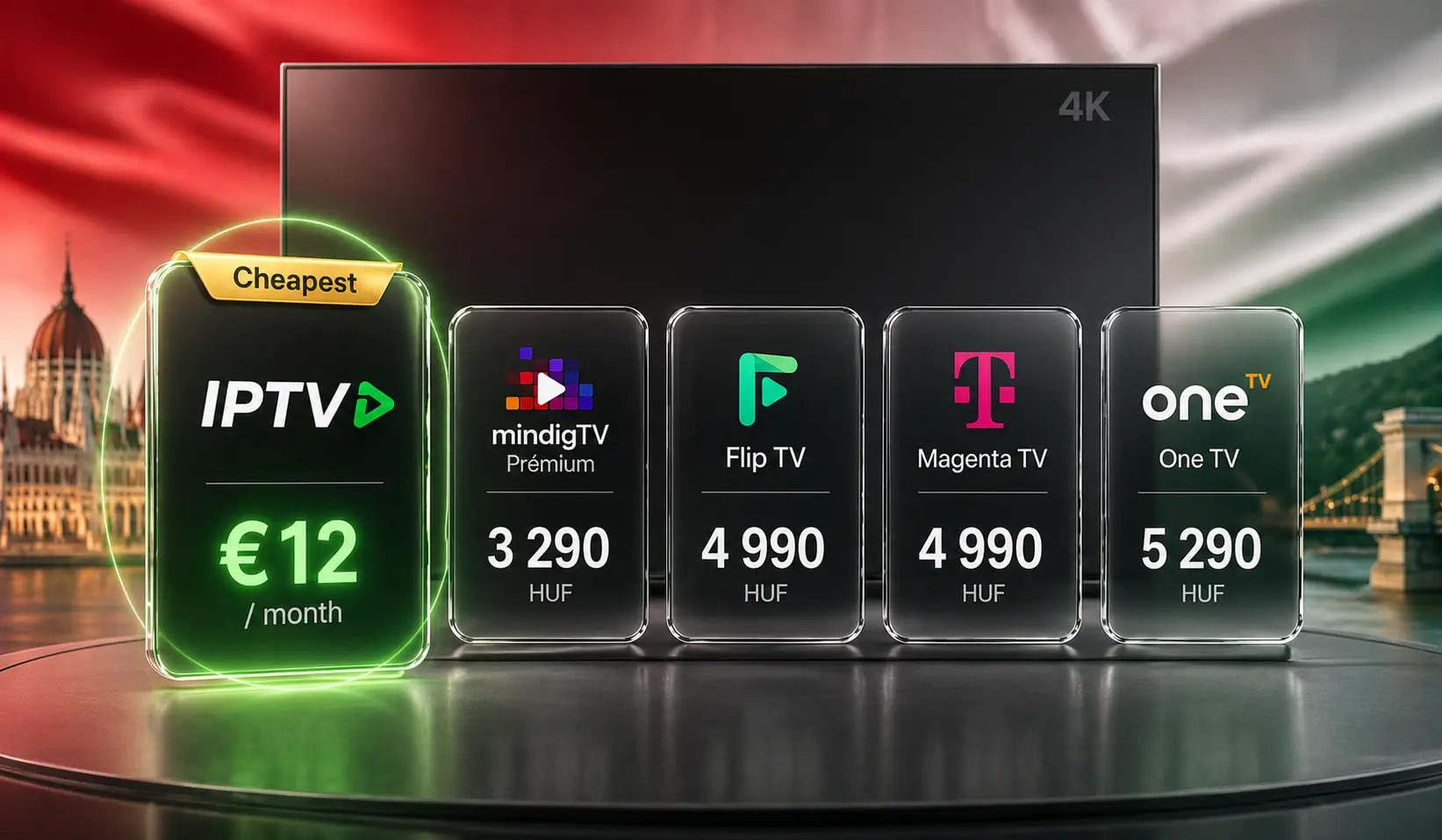
| mindigTV Prémium Alap | 3 290 HUF | ~30 | 1–2 yr | no | M1, M2, RTL, TV2 + ~14 |
| Flip TV (250 Mbps + TV) | 4 990 HUF | ~80 | 1 yr | partial | yes, base |
| Magenta TV S | 4 990 HUF | ~70 | 2 yr | no | yes, base |
| One TV Mini (ex-DIGI) | 5 290 HUF | ~85 | 1 yr | partial | yes |
| Magenta TV M | 6 990 HUF | ~120 | 2 yr | yes | yes |
| One TV Optimum | 7 290 HUF | ~140 | 1 yr | yes | yes |
| Magenta TV Now (app only) | 4 990 HUF | ~70 | none | no | yes |
| Netflix Standard | 3 990 HUF | no live | none | yes | no live HU |
| HBO Max | 2 390 HUF | no live | none | yes | no live HU |
| SkyShowtime | 1 990 HUF | no live | none | no | no live HU |
| Disney+ Standard | 3 200 HUF | no live | none | yes | no live HU |
Three things stand out. First, the independent IPTV subscription is the cheapest and most complete option across categories — more channels than any operator package. Second, streaming platforms (Netflix, HBO Max) are cheap on their own but none of them carry live Hungarian channels — they complement, not replace, a TV subscription. Third, the "cheapest operator package" always carries a 1–2 year contract and bundles in things you may not need (internet, phone).
The Magenta TV M row in the table is the post-rebrand successor of the legacy Szuper Családi HD csomag, renamed by Telekom in April 2022. We unpack its full channel list, contract terms, and 2026 all-in cost in a dedicated guide: see the Szuper Családi HD csomag breakdown if you're weighing whether to keep an older Telekom plan or switch to IPTV. If you specifically want to compare the price tiers, our IPTV super family HD plan price comparison breaks down which tariff offers the best value for a family.
Why IPTV is the cheapest TV subscription today
Six structural reasons make IPTV the cheapest TV subscription in Hungary in 2026. These are not marketing claims, they are measurable differences in service architecture and cost structure.
1. No cable infrastructure. IPTV travels over the public internet (HLS, M3U, M3U8, Xtream Codes API). The provider doesn't have to build and maintain a national wired network. Magyar Telekom, One Hungary and regional cable ISPs spend hundreds of millions of HUF on network upgrades every month — part of that cost lands on your bill. An IPTV provider only pays for content rights, EPG (XMLTV) and CDN servers.
2. No mandatory set-top box. Operator monthly fees include a STB rental (1 200–2 000 HUF) and smartcard charge. With IPTV, any Android TV box, Amazon Fire TV Stick, Apple TV, Chromecast, Samsung Tizen, LG webOS or Roku runs IPTV Smarters Pro, IBO Player, Smart IPTV, TiviMate, GSE Smart IPTV, Perfect Player, XCIPTV or MyIPTV — for free.
3. No contract, no early-exit fee. Operator low-end packages have a 1–2 year minimum term. Cancelling early triggers a 30–50 % penalty on the remaining months. IPTV subscriptions are billed monthly, quarterly, semi-annual or annual and can be stopped any time.
4. More channels for less money. A 48 000-channel IPTV plan covers Hungarian broadcasters, European sports (Sky Sport, BT Sport, beIN Sport), US premium tiers, Asian movie channels — content that no operator can license together. Magenta TV's flagship package gives ~200 channels — IPTV's base plan delivers 240× that.
5. Standalone, or on top of any internet. Operator "cheap TV" pricing usually only applies if you also order their internet and/or phone. So "4 990 HUF Magenta TV S" is in reality 9 990 HUF, because you need the 250 Mbps internet pack with it. IPTV runs on any internet — your own, shared, mobile hotspot — and the 4 200 HUF figure is final.
6. 4K UHD wherever the broadcast supports it. Operator entry packages still output 720p–1080i because the local headend serves thousands of households on shared bandwidth. IPTV CDNs scale horizontally and use HEVC/H.265 encoding, so almost everything plays at FHD/4K if your own internet delivers (≥ 50 Mbps for 4K).
For a thorough side-by-side — monthly cost, install time, channel count, picture quality, mobility — see the IPTV vs cable breakdown. When you're ready to look at concrete plans, the IPTV subscription packages post details the 1, 3, 6 and 12-month options.
Operator packages: Magenta TV, One TV, Flip
Hungarian operator (cable / fibre) TV packages start at the levels below in April 2026. "Cheapest" here means the base tier — fewer channels, mixed SD/HD, and almost always a contract.
Magyar Telekom — Magenta TV
Telekom keeps three TV tiers in 2026: Magenta TV S, M and L. Magenta TV S is 4 990 HUF/month (2-year contract) and includes ~70 channels in base HD. Sports and premium movie tiers are not included — those need Magenta TV M (6 990 HUF) or L (9 990 HUF). For app-only access (online streaming, no cable), Magenta TV Now is 4 990 HUF/month with no contract — but it's still limited to Telekom's licensed Hungarian channel mix. The full Magenta ecosystem is broken down in the Telekom IPTV service review.
One Hungary (ex-DIGI + Vodafone)
On 1 January 2025 DIGI Hungary and Vodafone Hungary merged as One Hungary. Former DIGI packages are now branded "One TV": One TV Mini starts at 5 290 HUF (~85 channels, 1-year contract), One TV Optimum at 7 290 HUF (~140 channels). The price-freeze moratorium expires in July 2026, after which the operator has announced 15–25 % increases — this is the biggest 2026 move on the cable side and the reason many households are looking for alternatives right now.
Flip
Flip is the cheapest operator entry in Hungary, but with limited geographical coverage — mostly Budapest and a few large cities. Flip TV (250 Mbps internet + ~80 TV channels) is 4 990 HUF/month with a 1-year contract and is the best operator deal for households inside Flip's footprint. Outside that footprint, it's not an option.
Yettel and Direct One
Yettel (ex-Telenor) and Direct One are smaller / regional / mobile-led players with limited channel lineups and varying pricing. Yettel MyTV is a mobile-first streaming app with a small Hungarian-channel set, suitable for occasional viewers. Direct One is satellite-based — used mostly in rural areas without cable.
For a one-page comparison of all Hungarian providers including the independents, the IPTV providers in Hungary post lists every category and what each delivers per HUF.
Activate your trial in just a few minutes
mindigTV Prémium — the over-the-air "free" option
mindigTV Prémium is the digital terrestrial (DVB-T2) TV service operated by Antenna Hungária. It's often confused with "free TV" — that label only fits the basic mindigTV bundle, where M1, M2, M3, Duna and a handful of public-service channels can be received unencrypted with a DVB-T2 tuner. The mindigTV Prémium Alap package, by contrast, is 3 290 HUF/month and adds about 30 channels: M1, M2, M3, M4 Sport, M5, Duna TV, Duna World, RTL Klub, RTL+, TV2, ATV, HírTV, Spektrum, Cool, Film+, plus a few music channels.
When does it make sense? When the household only watches Hungarian public-service media + RTL Klub + TV2 and nothing else; when 4K is not a concern; when sports tiers (Sky Sport, beIN, BT Sport) are not needed; and when international or English-language channels are irrelevant. That's the classic retiree profile. You'll need a DVB-T2 tuner (most 2018+ Hungarian TVs have one built in) and you should check the mindigTV.hu coverage map for your address.
When is it not enough? If the family watches sports, if you need kids' channels (Cartoon Network, Nickelodeon, Boomerang), if you want English-language content (BBC, CNN, NatGeo), or if you want 4K cinema-grade picture. In any of those cases, the 3 290 HUF is mostly wasted because you'll have to top it up with a second service.
A complete "cheap and complete" alternative that beats mindigTV on both channel count and price is an independent IPTV subscription — €5/month with 48 000+ channels on the same TV you already own. (Antenna Hungária's role and the official terrestrial coverage of Hungary are documented on the Antenna Hungária Wikipedia entry.)
Streaming platforms: Netflix, HBO Max, Disney+
International streaming platforms don't replace a TV subscription — they complement it. None of them carry live Hungarian channels, but all of them carry strong original productions (Netflix Originals, HBO Originals, Disney/Marvel/Star Wars).
| Platform | Monthly | What it adds | Worth it for |
|---|---|---|---|
| Netflix Standard (1080p) | 3 990 HUF | Movies, series, originals | Heavy Netflix Original viewers |
| Netflix Premium (4K) | 5 700 HUF | Above + 4K | True 4K cinephiles |
| HBO Max | 2 390 HUF | HBO + WB movies and series | House of the Dragon, Last of Us fans |
| SkyShowtime | 1 990 HUF | Paramount+, Sky, Showtime, NBC, CBS | Yellowstone, Star Trek fans |
| Disney+ Standard | 3 200 HUF | Disney, Marvel, Star Wars, NatGeo | Families with kids |
| Apple TV+ | 2 990 HUF | Apple TV+ originals (Severance, Ted Lasso) | Niche but strong |
| Amazon Prime Video | 2 990 HUF | Prime Originals + rentals | Existing Prime members |
The arithmetic reality: a Netflix + HBO Max + Disney+ + SkyShowtime stack runs 11 570 HUF/month — without a single live Hungarian channel and without sports. That's almost 3× the price of an IPTV subscription that already carries most of the same back-catalogue from its own streaming servers. The pattern most Hungarian households settled into in 2026 is one IPTV subscription for live channels, news and sports + one streaming platform (typically Netflix or HBO Max) for originals.
The streaming-vs-IPTV dynamic in Hungary specifically is detailed in the online TV subscription Hungary post.
How to save 5 000–8 000 HUF a month on TV
The average Hungarian household spends 9 800–14 500 HUF/month on TV (operator package + 1–2 streaming platforms). It doesn't have to be like that. An eight-step playbook for shaving 5 000–8 000 HUF without losing content.
1. Drop the mandatory STB rental
Many households have been paying 1 200–2 000 HUF/month for a set-top box rental for years, while their Smart TV already runs the same apps. If your operator allows app-only (Magenta TV Now, One TV Go), switch — that's 14 400–24 000 HUF/year saved.
2. Audit what you actually watch
Spend a week noting which channels you actually start. Most households use 8–12 channels regularly but pay for 120 channels in a 6 990 HUF package. Pick the package that matches what you watch — not the package that "might" be useful.
3. Unbundle TV from internet
Operator "TV + internet" bundles run 7 990–12 990 HUF and almost always cost more than the parts bought separately. Separately: 250 Mbps internet (~3 990 HUF) + IPTV subscription (1 990 HUF) = 5 980 HUF — same speed, more channels.
4. Switch to annual billing
An IPTV subscription is 4 200 HUF on a 1-month plan and 1 990 HUF/month on a 12-month plan (23 880 HUF/year — ~50 % cheaper). If you know you're staying, take the annual option.
5. Cancel duplicate streamers
If you have Netflix and HBO Max and Disney+, you're probably only paying any one of them for its originals. Keep one, resubscribe to the next when a new season drops (streamers are month-to-month).
6. Use one subscription on multiple devices
An IPTV subscription runs on multiple devices simultaneously on a single fee. A family where each member pays for their own platform (Netflix for one kid, Disney+ for the other, cable for the parents) can consolidate into one IPTV subscription with parallel streams — confirm the simultaneous-connection limit with support before you order.
7. Watch for seasonal deals
Our WhatsApp support pushes seasonal deals (Black Friday, end-of-year, spring). A 12-month plan can drop to ~19 990 HUF — that's 1 666 HUF/month.
8. Take the trial seriously
Before you commit a year of payments to a new IPTV provider, request a 3–5 day or free trial. The free trial IPTV guide lists exactly what to test during the trial so you don't end up with a bad provider.
The savings principle is simple: pay for content, not infrastructure. Operators run 30-year-old cable networks, regional technical centres, install crews and STB inventories — all baked into the monthly fee. IPTV pays for content rights and servers, nothing else.
Chat with our 24/7 support team
Devices: where can you watch the cheapest TV plan?
The cheapest TV subscription (IPTV) is device-agnostic — anything with internet and an app store works. Six platforms run out-of-the-box in 2026.
Smart TVs (Samsung Tizen, LG webOS). Most 2018+ Samsung and LG TVs have Smart IPTV, IBO Player or similar apps in their store, or sideloadable. Samsung Tizen and LG webOS TVs run IPTV apps natively, with about 5 minutes of setup.
Android TV / Google TV (Sony, Xiaomi, TCL, Hisense, Philips). These get IPTV Smarters Pro, TiviMate (the power-user favourite), GSE Smart IPTV, Perfect Player, XCIPTV or MyIPTV from Google Play. Two or three steps to activate.
Android TV box. Any 30 000–60 000 HUF Android TV box (Xiaomi Mi Box, Mecool, X96) runs IPTV. It's the most flexible option — useful when your existing TV is older (no DVB-T2, no apps), since the box handles everything.
Amazon Fire TV Stick. Fire TV Stick 4K Max (~30 000 HUF) is one of the easiest entry points — install Smarters Pro from the Fire TV App Store and you're done. Concrete model recommendations are in the best devices for IPTV guide.
Apple TV (4th gen and newer). Apple TV 4K runs iTuner / IPTV Smarters Player. Higher hardware cost (60 000–80 000 HUF), but the most stable picture and best Wi-Fi performance.
Phone / tablet. iOS and Android phones and tablets run Smarters Pro or IBO Player. For travel, or as a TV replacement when you don't have a screen.
All of the devices above receive the same Hungarian IPTV channel lineup — one subscription, multiple devices, usually with parallel streams allowed. Chromecast alone isn't enough (it needs a phone to "cast" from), but if you already have a phone, that combination works.
A model-by-model compatibility map across Tizen, webOS, Roku, Apple, Android is in the best IPTV player overview.
What a "cheap but not bad" TV plan must include
Cheap on its own isn't a goal — cheap without value is just waste. A good "cheapest TV subscription" passes all eight tests below. If any of them fails, the saving is illusory.
1. Full Hungarian channel lineup. M1, M2, M3, M4 Sport, M5, Duna TV, Duna World, RTL Klub, RTL+, TV2, TV2 Play, ATV, HírTV, Spektrum, Cool, Film+, Sport1, Sport2 — without these, a Hungarian household has no use for a TV subscription. A "cheap" plan that only carries M1 and Duna isn't cheap, it's incomplete.
2. Live broadcast. Streaming platforms (Netflix, HBO Max) are on-demand. Live news, live football, live political coverage is only on live TV channels. A real TV subscription is live.
3. EPG (programme guide). XMLTV-driven electronic programme guide — without it, the subscription is "blind". Every serious IPTV provider includes an EPG; verify it during the trial.
4. 1080p minimum, 4K optional. 720p is no longer acceptable in 2026 — Hungarian Smart TVs are 4K-native, and FHD displays handle 1080p well. If a "cheap" plan only outputs 720p, you're paying for outdated tech.
5. Stable servers, low buffering. A "cheap" IPTV provider whose stream stutters for 30 minutes a day isn't actually cheap. The trial period is the right test — common questions are also answered on our FAQ page.
6. EPG, time-shift, catch-up. A modern service should let you rewind live (time-shift) and replay the last 1–7 days of a channel (catch-up).
7. No contract. A contract package is never cheap — only cheap upfront. A 24-month commitment locks you into 60 000+ HUF/year on something you may not even use later.
8. 24/7 customer support. WhatsApp customer support, in Hungarian or English. If the stream dies at 21:00 during an important match and the provider only answers Mon–Fri 9–17, the "cheap" plan turns expensive immediately.
The Hungary IPTV plans hit all eight criteria — which is why the comparison against operator entry packages doesn't sacrifice anything on the content side.
Hungarian channels abroad — diaspora option
More than a million Hungarians live outside Hungary — across Europe, the US, Canada, Australia, Israel and Germany. For them, traditional Hungarian cable is technically unreachable (operators only serve their own country) and Magenta TV Now, One TV Go and similar apps are geo-blocked: without a Hungarian IP address they don't run.
IPTV is the only realistic option from abroad. Hungary IPTV servers can be reached from anywhere — Germany, Vienna, Toronto, Los Angeles, Sydney, Tel Aviv. The same 48 000+ channels, the same Hungarian M1–M5, RTL, TV2, live and in HD.
Three typical diaspora profiles:
- The long-time expat retiree who follows M1 news bulletins and the RTL Klub evening line-up. 4–5 hours/week of live Hungarian TV.
- The recently relocated young family who reintroduces the Hungarian TV experience to the kids once a week (M2 cartoons, Duna). 2–3 hours/week.
- The international sports fan who tracks Hungary's national football team, water polo, handball and swimming on M4 Sport.
All three profiles are covered by 1 990–4 200 HUF/month — a single IPTV subscription. The full diaspora playbook, payment methods, and recommended packages are in the Magyar IPTV guide. For the geo-blocking specifics on Magenta TV / DIGI / One TV, the providers that actually work cross-border, and city-by-city experience in Toronto, London, Vienna, Berlin, and New York, see our Hungarian IPTV providers abroad 2026 analysis.
Subscribe and start streaming in 5 minutes
Activation in 5 minutes — step by step
Activation is one of the strongest cost advantages of the cheapest TV subscription: 5 minutes, no technician, no hardware swap. Operator install time is 5–14 days (appointment booking, on-site visit, drilling, cable pulling). IPTV setup is four steps:
- Pick a plan. Choose from 1, 3, 6, 12 and 24-month options. If you're unsure, start with 3 months — you'll know what you actually watch by the end.
- Pay. Card, PayPal, crypto or bank transfer. Confirmation is instant.
- Receive activation credentials. An email or WhatsApp message arrives with your M3U URL, or Xtream Codes API combo (server, username, password). Enter those into your TV or app.
- App + credentials = done. Smart TV → SmartIPTV / IBO Player / Smarters Pro; Android TV or box → Smarters Pro or TiviMate; phone → same. The stream starts immediately.
Most Hungarian customers order on Wednesday at 18:00 and are watching Hungary play football on M4 Sport on Thursday at 18:00. If you struggle with the setup, our WhatsApp customer support walks you through it — 24/7, in Hungarian or English.
Common mistakes that make you overpay
A decade of Hungarian TV market habits has produced behaviours that suit operators but drain your wallet. The five most common.
1. "I've been with this provider for 8 years." "Loyal customers" are the most expensive customers — best deals go to new sign-ups. Spend 30 minutes once a year reviewing your contract against the market.
2. "Cable is more reliable than internet." Technically the opposite is true: a cable signal comes from a local headend and if it fails the whole street loses TV. IPTV CDNs are geo-distributed and redundant. The last large-scale Hungarian cable outage was 4 hours nationwide in 2022.
3. "A 24-month contract is cheaper." Only the monthly figure is cheaper. Cancel mid-term and you pay penalty. If service degrades after 6 months, you still pay for the remaining 18. Monthly (or at most annual) billing is more flexible.
4. "IPTV is illegal." Licensed IPTV providers (such as Hungary IPTV) buy content rights — same as Magenta TV or One. "Free IPTV" on Telegram is a different category, but legitimate paid providers operate with full rights.
5. "I'm not technical, I won't touch it." A 75-year-old grandmother can set up IPTV in 5 minutes once someone shows her once. Customer support guides on WhatsApp. "Not technical" often costs 60 000 HUF/year in unnecessary fees.
Summary: which is the cheapest TV subscription for you?
Four typical Hungarian household profiles in 2026, with a precise answer for each.
- Only Hungarian public media + RTL/TV2, nothing else. → mindigTV Prémium Alap (3 290 HUF/month) if reception is good at your address. If not, IPTV base plan (1 990 HUF/month).
- Hungarian channels + sport + movies + international curiosity. → 12-month IPTV subscription (1 990 HUF/month). Cheapest complete option.
- Live channels + Netflix/HBO Max originals. → IPTV (1 990 HUF) + 1 streamer (2 390–3 990 HUF) = 4 380–5 980 HUF/month. Cheaper than any operator package and with more channels.
- Watching Hungarian TV from abroad. → IPTV subscription (1 990 HUF/month). Magenta TV Now and One TV Go are geo-blocked; IPTV is the only thing that works.
The 2026 rule of thumb: don't pay for cable infrastructure when the same content is available over the internet — twice the channels, half the price. An operator package only makes sense if you also need their internet there and bundle a locally-required component (e.g. landline).
The cheapest TV subscription in Hungary today is unambiguously IPTV — the full plan catalogue (monthly, 3, 6, 12 and 24-month pricing with channel breakdown) is on the Hungary IPTV pricing page. Order, 5-minute activation, done.
FAQ — Cheapest TV subscription Hungary
What is the cheapest TV subscription in Hungary in 2026?
The cheapest full-featured TV subscription in Hungary in 2026 is an IPTV subscription from €5/month (~1 990 HUF) on a 12-month plan, delivering 48 000+ channels in 4K with no contract. Operator base packages (Magenta TV S, One TV Mini) cost 2.5–3.5× as much for fewer channels.
Can I really get a TV subscription for €5/month?
Yes. The 12-month IPTV plan totals ~23 880 HUF/year, which is €5 (~1 990 HUF) per month. On a shorter (1 or 3-month) plan the monthly figure is around €11 (~4 200 HUF) — still cheaper than Magenta TV S (4 990 HUF) or Flip TV (4 990 HUF).
Is mindigTV Prémium free?
No. mindigTV Prémium Alap is 3 290 HUF/month for ~30 channels. The "free" mindigTV is only the public-service basic tier (M1, M2, Duna), unencrypted and received with a DVB-T2 tuner. The full Prémium lineup is paid.
Is IPTV legal in Hungary?
Yes, when you order from a licensed provider. Licensed IPTV providers buy content rights the same way Magenta TV or One Hungary do. "Free IPTV" links shared on Telegram are illegal, but paid IPTV providers (such as Hungary IPTV) operate with full legal rights. The Hungarian regulatory context is supervised by NMHH (Nemzeti Média- és Hírközlési Hatóság).
What's the difference between IPTV and Netflix?
IPTV delivers live TV channels (M1 news, RTL Klub prime time, M4 Sport matches, BBC, CNN, Sky Sport) including archive and catch-up. Netflix is on-demand films and series with originals (Stranger Things, Squid Game) but no live TV. In Hungary most households don't replace one with the other — they combine: IPTV for live + Netflix for originals.
Can I cancel month-to-month?
Yes. An IPTV subscription has no contract — it's cancellable monthly. A 1-month plan (4 200 HUF) simply expires at the end of the month if you don't renew, with no penalty. Operator packages (Magenta TV S, One TV Mini) lock you in for 1–2 years.
How many devices can stream simultaneously?
An IPTV subscription lets you register several devices — TV, phone, tablet and Android TV box — but registering them is not the same as streaming on all of them at once. On Hungary IPTV Basic, simultaneous streaming is a separately activated feature; Premium supports up to 3 simultaneous streams depending on configuration. WhatsApp support confirms the exact setup before you subscribe.
Do I need a separate set-top box?
No. IPTV runs on any Smart TV (Samsung Tizen, LG webOS), Android TV, Apple TV, Fire TV Stick, Android TV box, Roku or phone — through a free app, on your existing internet. Operator packages usually require their own STB at 1 200–2 000 HUF/month rental.
What happens when the subscription expires?
After expiry, the IPTV subscription can be renewed instantly — same servers, or you can move to another provider. WhatsApp support sends a reminder 7 days before expiry. With operator contracts you have to sign a renewal which can take 7–30 days.
Does Hungarian IPTV work from abroad?
Yes. Hungary IPTV servers are reachable from anywhere — Germany, Austria, the Netherlands, the UK, the US, Canada, Australia, Israel. The full Hungarian lineup (M1, M2, M3, M4 Sport, M5, Duna, RTL Klub, TV2, ATV, HírTV) plays exactly as it does inside Hungary.
How do I order?
Three steps. (1) Pick a plan — the 12-month plan is the most popular. (2) Pay by card, PayPal, crypto or bank transfer. (3) Receive activation details by email or WhatsApp within 5 minutes. For any setup question: WhatsApp support, 24/7, English or Hungarian.
The Hungary IPTV Team has been helping customers in Hungary, Europe, Canada and the USA enjoy seamless IPTV streaming since 2022. Our support team is available 24/7 on WhatsApp for setup, troubleshooting, and subscription questions.